

200 Litre Heat pump hot water cylinder
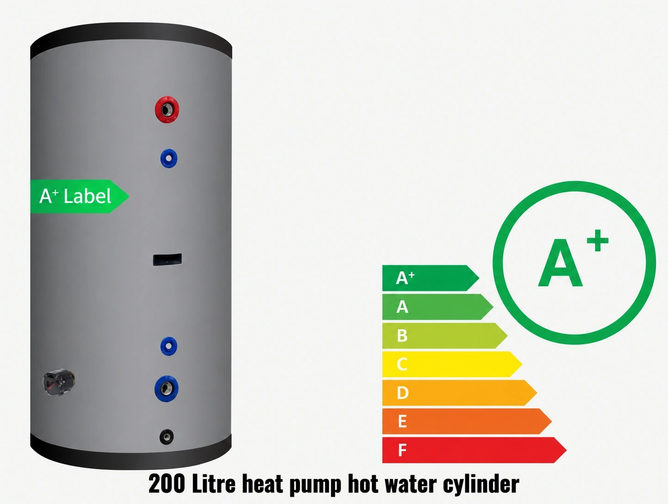
Our 200 litre heat pump hot water cylinder is an indirect hot water cylinder designed for use with an external air source or ground source heat pump system. Its large surface area heat exchanger coil is specifically suited to the lower primary flow temperatures produced by heat pumps, helping to transfer heat efficiently into the stored domestic hot water. With a nominal 200 litre stored water capacity, it provides a practical solution for homes with moderate hot water demand while still offering good recovery performance, mains pressure hot water when used in an unvented configuration and compatibility with modern low-temperature heating systems to help reduce carbon emissions and energy bills.
This 200 litre heat pump cylinder is a floor-mounted unit that has a class-leading ErP “A+” rating in accordance with Commission Delegated Regulation (EU) No 812/2013, an EU regulation that sets out energy labelling requirements and supplementary product information for water heaters and hot water storage tanks.
Heat pump cylinder
A heat pump cylinder is an indirect hot water cylinder with a large, high-efficiency heat exchanger specifically designed to transfer heat effectively from the lower primary water temperatures produced by heat pump systems. These heat pumps can either be an air source heat pump or a ground source heat pump.
These are not integrated heat pump cylinders, which have a heat pump cylinder and an air source heat pump combined in one integral unit, i.e., an integrated heat pump water heater using heat pump technology.
We do supply this type of integrated air source heat pump water heater, and this is detailed on this webpage: 200 litre air source heat pump water heater
Why Heat Pump Cylinders Need a Larger Coil
A conventional oil boiler or gas boiler may produce primary water at 70°C or higher, whereas a heat pump typically operates at much lower temperatures, usually anywhere from 35°C to 55°C.
Therefore, a heat pump cylinder generally needs a larger heat exchanger surface area to achieve effective heat transfer.
This fact distinguishes a heat-pump-optimised cylinder from a standard indirect cylinder.
Larger 32 mm coil heat exchanger
Our heat pump cylinders use a large 32 mm diameter corrugated stainless-steel heat exchanger coil, designed to accommodate the higher primary water flow rates typically required by air source and ground source heat pumps. The large-bore construction helps to minimise the pressure drop through the cylinder coil, which reduces the pump head required to maintain the correct flow rate.
This helps reduce circulation pump energy consumption, allowing the pump to operate at a lower speed and helping ensure that the heat pump receives the water flow it requires to deliver its rated heating output.
| Heat Exchanger Detail | |
| Exchanger type | High-flow corrugated heat pump heat exchanger |
| Exchanger design | Ø32 mm corrugated pipe coil |
| Exchanger material | 316L stainless steel |
| Exchanger length [m] | 15 |
| Exchanger surface area [m²] | 2.3 |
| Exchanger volume [L] | 10 |
| Maximum pressure [bar] | 10 |
| Maximum temperature [°C] | 95 |
The corrugated surface also promotes turbulence within the primary water, helping maintain effective heat transfer while benefiting from the lower hydraulic resistance associated with the larger coil diameter.
Duplex 2205 Stainless Steel Hot Water Cylinder
The hot water cylinder is manufactured from Duplex 2205 stainless steel, offering high corrosion resistance, mechanical strength and long service life. This premium stainless steel makes the units suitable for soft and hard water areas. Unlike a glass-lined hot water cylinder, no sacrificial anodes are required.
ErP A+ Rated Energy Efficiency
Our 200 litre heat pump cylinder has a class-leading ErP energy efficiency rating of A+, helping to minimise heat loss from the stored domestic hot water. High levels of cylinder insulation allow the water to remain hotter for longer, reducing the amount of energy the heat pump needs to use to maintain the required temperature. This can help lower overall energy consumption and running costs while allowing the heat pump system to operate as efficiently as possible.
For homeowners looking to maximise the benefits of an air source or ground source heat pump, an A+ rated hot water cylinder provides an efficient and well-insulated solution for storing domestic hot water.
Specifications of our 200L heat pump water heater
Technical data of our 200 L stainless steel DHW cylinder/heat pump water heater
|
Dimensions and connection details |
||||
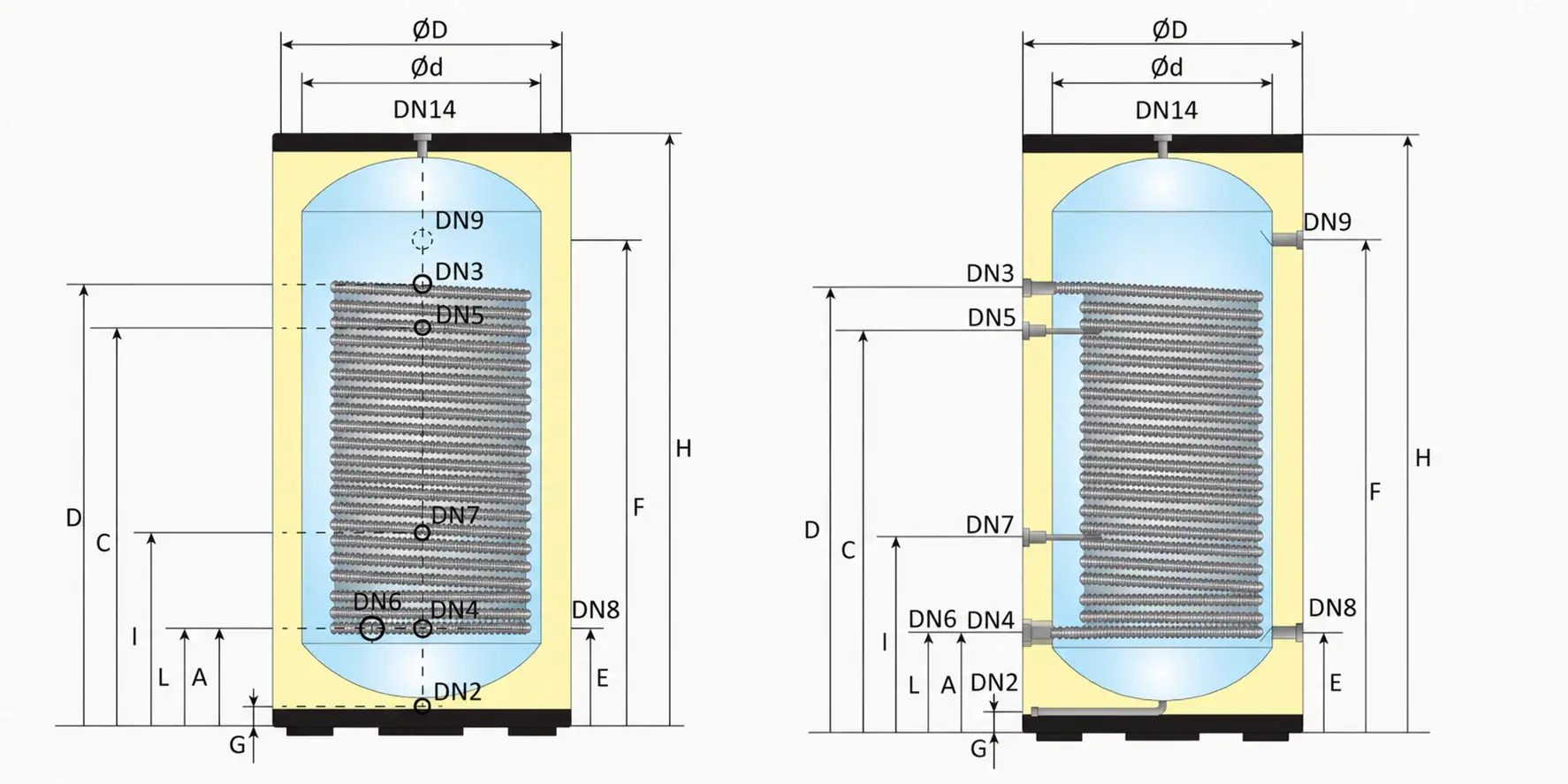
| H | All connections are female BSP | Height | 1340 mm | |
| ØD | ØD Outer diameter | 600 mm | ||
| Ød | Ød Inner diameter | 470 mm | ||
| H | DN 14 | G 3/4″ | P&T safety valve connection | 1340 mm |
| D | DN 3 | G 1″ | Ø32 mm AISI 316L stainless steel XL heat exchanger – inlet | 1015 mm |
| A | DN 4 | G 1″ | Ø32 mm AISI 316L stainless steel XL heat exchanger – outlet | 265 mm |
| C | DN 5 | G 3/4″ | Sensor pocket (1) | 905 mm |
| L | DN 6 | G 1 1/2″ | Electric immersion heater port | 265 mm |
| I | DN 7 | G 3/4″ | Sensor pocket (2) | 465 mm |
| E | DN 8 | G 1″ | Connection inlet/outlet | 265 mm |
| F | DN 9 | G 1″ | Connection inlet/outlet | 1100 mm |
| P | DN 2 | G 1/2″ | Drain port | 53 mm |
Pressure and temperature ratings
| Tank material | Stainless steel Duplex 2205 |
| Maximum operating / test pressure |
6/10 bar |
| Maximum tank temperature [C] |
95 |
Air source heat pump
Air source heat pumps, in contrast to gas boilers, are made to operate continuously at low flow temperatures, usually between 35°C and 55°C, with return temperatures typically running 5°C to 10°C lower. This enables them to consistently maintain indoor comfort for the property while effectively extracting renewable heat from outside air.
They usually have a domestic hot water priority system that allows the air source heat pump to ramp up to its highest temperature (normally 55°C) to help with DHW heating performance and recovery times of the indirect hot water cylinder they are connected to.
Heat pump capacity depends heavily on the size, age, and insulation standard of a building rather than bedroom count alone. General industry averages include
- Small flats or well-insulated terraces: 4 kW – 5 kW
- Modern or average 3-bedroom semi-detached houses: 5 kW – 10 kW
- Larger or older detached houses: 10 kW – 16 kW
Hot water heating system
The rules for heating water are as follows:
The domestic hot water heating performance of a heat pump cylinder is influenced by both the primary flow temperature entering the coil and the water flow rate through the coil. A higher primary flow temperature increases the temperature difference between the coil and the stored domestic hot water, improving heat transfer and thus hot water performance. At the same time, sufficient primary flow is needed to carry that heat through the coil effectively.
The heat transferred can be related to the flow rate and the temperature difference between the primary flow and return, often expressed as the formula Q = ṁ × Cp × ΔT.
- Q = heat output or heat transfer rate, in kW
- ṁ = mass flow rate of the water, in kg/s
- Cp = specific heat capacity of water, approximately 4.186 kJ/kg·K
- ΔT = temperature difference between the primary flow and return, in °C or K
So, in simple terms:
Heat output = how much water is flowing × how much energy the water can carry × how much its temperature drops.
For this reason, coil performance should not be considered from coil surface area alone, as flow temperature, flow rate and primary flow/return ΔT all affect the actual heat output and cylinder recovery time.
Our 200 Litre domestic hot water cylinder designed for heat pumps can produce the following outputs:
Based on a 55°C flow/45°C return (a delta T of 10°C), our heat pump cylinder will produce approximately 20 kW of output when heating water from 10°C to 45°C, which equates to 491 litres of DHW raised from 10°C to 45°C per hour.
Based on a 55°C flow/50°C return (a delta T of 5°C), our heat pump cylinder will produce approximately 22 kW of output when heating water from 10°C to 45°C, which equates to 532 litres of DHW raised from 10°C to 45°C per hour.
Please note: no heat exchanger coil is 100% efficient; thus, you would need an air source heat pump with a rated output of around 25 kW (in the case of the Delta T5C system) available capacity at 55°C to provide sensible system margin.
There are variable factors that will affect the heating coil performance, such as if there is a glycol mixture in the primary heating fluid, flow rate difference, etc. The above calculation is based on no glycol in the primary heating fluid.
Second note: a larger heat pump will not necessarily make the cylinder heat faster once you reach the transfer limit of the coil. If the coil can transfer a maximum of approximately 20 kW under those conditions, connecting a 30 kW heat pump does not automatically give you 30 kW of DHW heating. The coil becomes the limiting factor.
So, for example, for a 3-bed semi-detached property with a 10 to 12 kW air source heat pump, you’re looking at around 245 litres per hour of DHW raised from 10 to 45°C, with a flow and return of 55°C/45°C to the heating coil of the hot water cylinder for heat pumps.
Immersion Heater Backup
Our heat pump water heaters come with an immersion heater port on the hot water cylinder. This allows an immersion heater or immersion element to provide supplementary and backup heating for the hot water tank and thus the hot water system. It also provides a temperature boost for Legionella protection.
Unvented cylinder
We can supply this heat pump cylinder in either an unvented or vented configuration.
Unvented cylinders can provide higher mains-pressure hot water without requiring a cold-water storage tank. Unvented cylinders need robust incoming mains water pressure and flow rates for performance. Unvented systems can deliver balanced water pressure to multiple outlets simultaneously.
The compatible unvented kit includes an expansion vessel for installation in the system, which accommodates the expansion volume of the heated water. You will also require a pressure and temperature valve, rated to the power you are feeding into the tank.
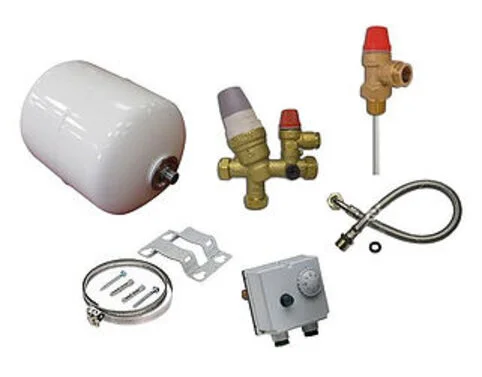
Unvented cylinders must comply with local safety regulations for installation. To legally fit, service, or maintain an unvented hot water cylinder larger than 15 litres, the installer must hold the current G3 unvented hot water qualification, which is often referred to simply as a G3 certificate or card.
Legionella Protection and Risk Management
As with any stored hot water system, the cylinder should be operated with suitable controls to help manage the risk of Legionella bacteria. In heat pump systems, the normal hot water temperature may be lower than that used with a conventional boiler, so the system can be programmed to periodically raise the cylinder temperature to 60°C or more for thermal disinfection.
Depending on the heat pump and its maximum flow temperature, this higher temperature may be achieved by the heat pump itself or with assistance from the cylinder’s immersion heater. The exact temperature settings and operating cycle should follow the heat pump manufacturer’s instructions and the requirements of the overall hot water system.
Commercial Hot Water Applications
In commercial buildings where temperature is used to control the risk of Legionella, stored domestic hot water should be maintained at 60°C or above in accordance with UK HSE guidance for commercial heating.
When a heat pump is used to heat an indirect hot water cylinder, it is therefore important to ensure that the complete system can achieve the required storage temperature. Depending on the heat pump’s maximum flow temperature, the required temperature may be achieved by the heat pump alone or with supplementary heating from the cylinder’s electric immersion heater.
This is particularly important in commercial hot water systems, where maintaining appropriate storage and distribution temperatures is part of the building’s strategy for managing Legionella risk.
Contact Flexiheat UK
For more detailed information, stock availability, delivery times, price or to order/purchase our cost-effective and energy-efficient indirect 200 litre heat pump hot water cylinder in premium duplex stainless steel.
Please contact our sales team at 01202 822221 or use our website’s email contact form to discuss your requirements.